
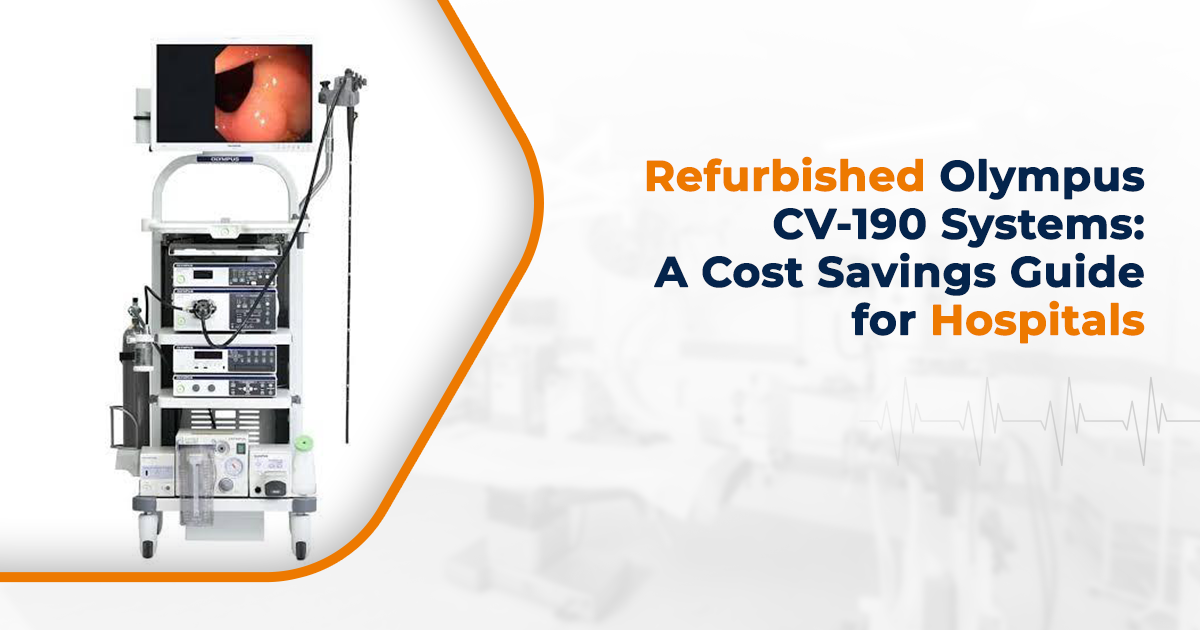
What if upgrading your endoscopy setup didn’t require stretching your budget to its limits?
For many hospitals, investing in advanced endoscopy technology often raises questions around long-term value, sustainability, and responsible resource allocation.
While high-end systems like the Olympus CV-190 are known for their imaging precision and clinical reliability, the cost of a brand-new unit requires careful financial planning for many hospitals.
This is where refurbished solutions are changing the conversation.
Today, hospitals are increasingly turning to cost-effective endoscopy systems that deliver performance without the financial strain. The demand for refurbished endoscopy equipment is rising, not just for cost efficiency, but for sustainable capital allocation and smarter healthcare investment.
Let’s break down how refurbished CV-190 systems can offer real savings, what to look for before buying, and how hospitals can make financially sound decisions.
ROI Calculator: Break-Even Analysis for Refurbished vs New CV-190
When evaluating whether to invest in a refurbished or new system, the key question is simple:
How quickly will the investment pay for itself?
A new Olympus CV-190 system typically comes with a high upfront cost, while a refurbished unit can cost significantly less, often 40–60% lower depending on condition, configuration, and support.
Basic ROI Perspective:
- New System: Higher capital investment → Longer break-even period
- Refurbished System: Lower investment → Faster return on investment
For example, consider a hospital performing 8–10 endoscopy procedures per day. With average procedure revenue, a refurbished system can help recover costs much faster, allowing hospitals to:
- Reinvest in other critical infrastructure
- Expand services without heavy financial burden
In many cases, the break-even period for refurbished systems can be reduced by several months or even years compared to new purchases.
The takeaway?
Every equipment investment is measured by patient outcomes. With a properly refurbished CV-190, clinical performance remains uncompromised.
Quality Assurance Checklist: What to Verify Before Buying Refurbished CV-190
While refurbished equipment offers cost advantages, quality remains non-negotiable. Not all refurbished systems are equal, which makes due diligence essential.
Here’s what hospitals should verify:
1. System Testing & Calibration
Ensure the unit has undergone complete performance testing and calibration aligned with manufacturer standards.
2. Image Quality & Processor Performance
The CV-190 is known for advanced imaging. Always verify clarity, color accuracy, and functionality during a demo or trial run.
3. Component Condition
Check critical components such as light source, processor, connectors, and internal modules for wear and reliability.
4. Service History & Refurbishment Process
Understand how the system was refurbished:
- Was it done by certified technicians?
- Were original parts used where required?
5. Warranty & After-Sales Support
A trusted provider should offer:
- Service support
- Spare parts availability
- Technical assistance
- Quick on-site service by field service engineers available in your region
A strong refurbishment process ensures that hospitals get performance close to new systems—without paying the full price.
Financing Options & Government Schemes for Endoscopy Equipment in India
Even with reduced costs, hospitals often explore financing options to manage cash flow efficiently.
1. Equipment Financing & Leasing
Many financial institutions offer:
- Medical equipment loans
- Flexible EMI structures
- Lease-to-own options
This allows hospitals to adopt advanced systems without large upfront payments.
2. Government Healthcare Schemes
In India, various central and state initiatives support healthcare infrastructure development, especially for:
- Tier 2 and Tier 3 cities
- Diagnostic and specialty hospitals
While schemes vary by region, they may include:
- Subsidies
- Credit-linked support
- Infrastructure development programs
Hospitals should explore eligibility under programs aligned with healthcare expansion and modernization.
3. Strategic Budget Allocation
Choosing refurbished systems also frees up capital, enabling hospitals to:
- Invest in additional departments
- Upgrade other diagnostic tools
- Improve patient care facilities
Combining cost-effective purchasing with smart financing creates a more sustainable growth model.
Conclusion
Investing in advanced endoscopy systems like the Olympus CV-190 doesn’t have to be financially overwhelming.
Refurbished solutions offer a practical balance between performance and affordability—helping hospitals access high-quality technology while maintaining financial flexibility.
With proper quality checks, reliable vendors, and the right financial planning, refurbished systems can deliver:
- Uncompromised patient safety
- Consistent clinical performance
- Scalable growth opportunities
For Indian hospitals aiming to expand efficiently, the shift toward smarter investments is already underway.
To discuss equipment requirements or long-term service support for your facility, contact Medinnova Systems at info@medinnovasystems.com or call +91-9512-106062.
FAQs
- How long does a refurbished CV-190 system typically last?
With proper maintenance and regular servicing, a refurbished system can deliver reliable performance for several years, comparable to new systems in many cases. - Can refurbished systems be upgraded later?
Yes, depending on the configuration, many refurbished systems can be integrated with compatible accessories or upgraded components over time. - Is training required when switching to a CV-190 system?
Minimal training may be required if transitioning from older systems, mainly to understand enhanced imaging features and workflow improvements. - How quickly can a refurbished system be deployed in a hospital?
Refurbished systems often have shorter lead times compared to new equipment, allowing faster installation and operational readiness. - Are spare parts easily available for refurbished endoscopy systems?
Availability depends on the supplier, but established providers ensure consistent access to spare parts and technical support.